


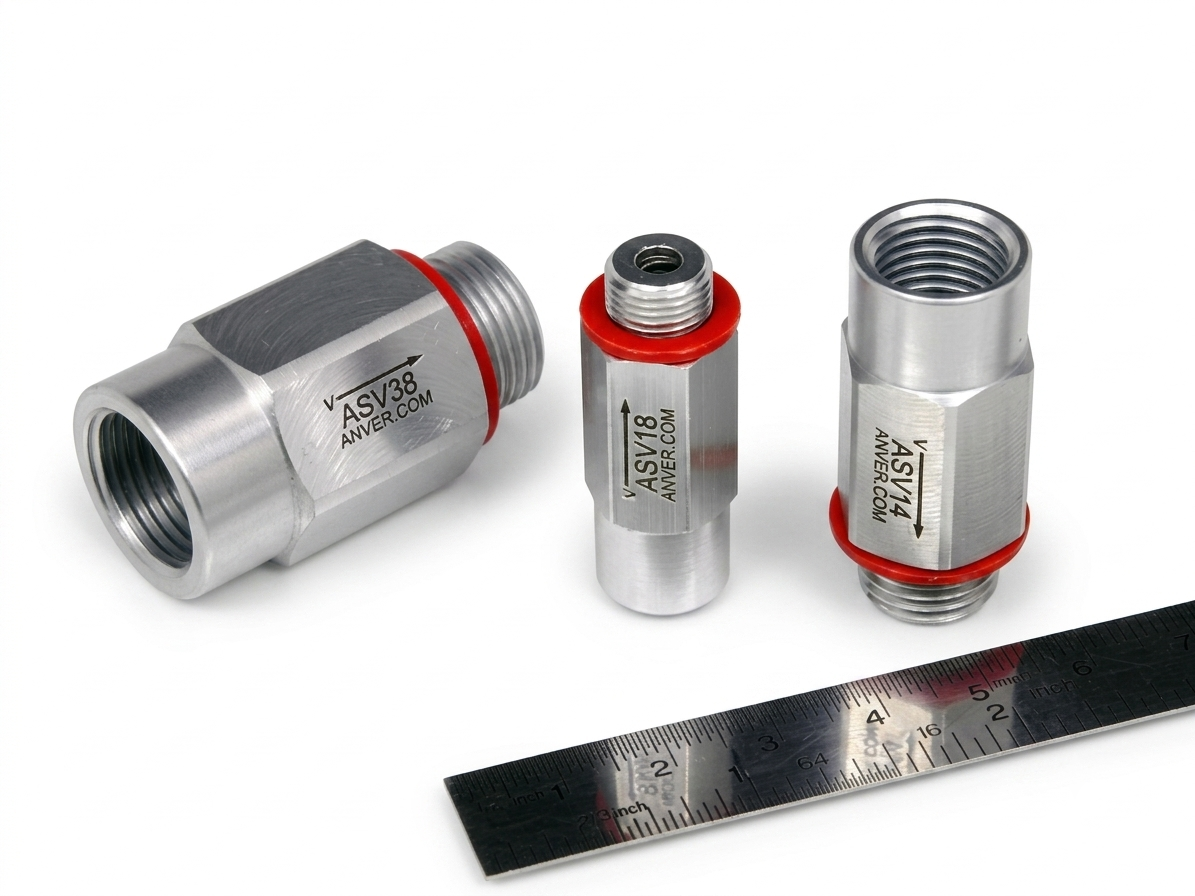


Description
VACUUM SENSING VALVES
Automatic and mechanical sensing valves – an economical and effective way of conserving vacuum
Product Overview
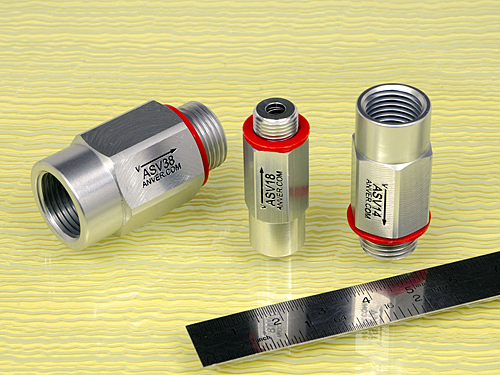
Metered flow sensing valves placed on cups used to pick and place products
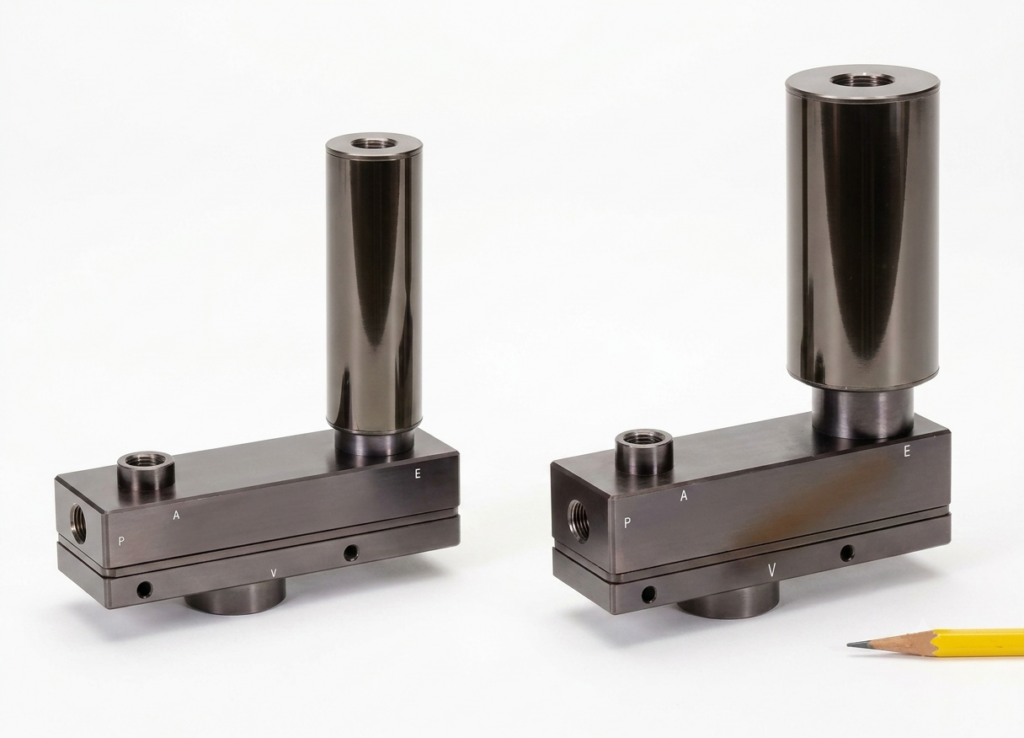
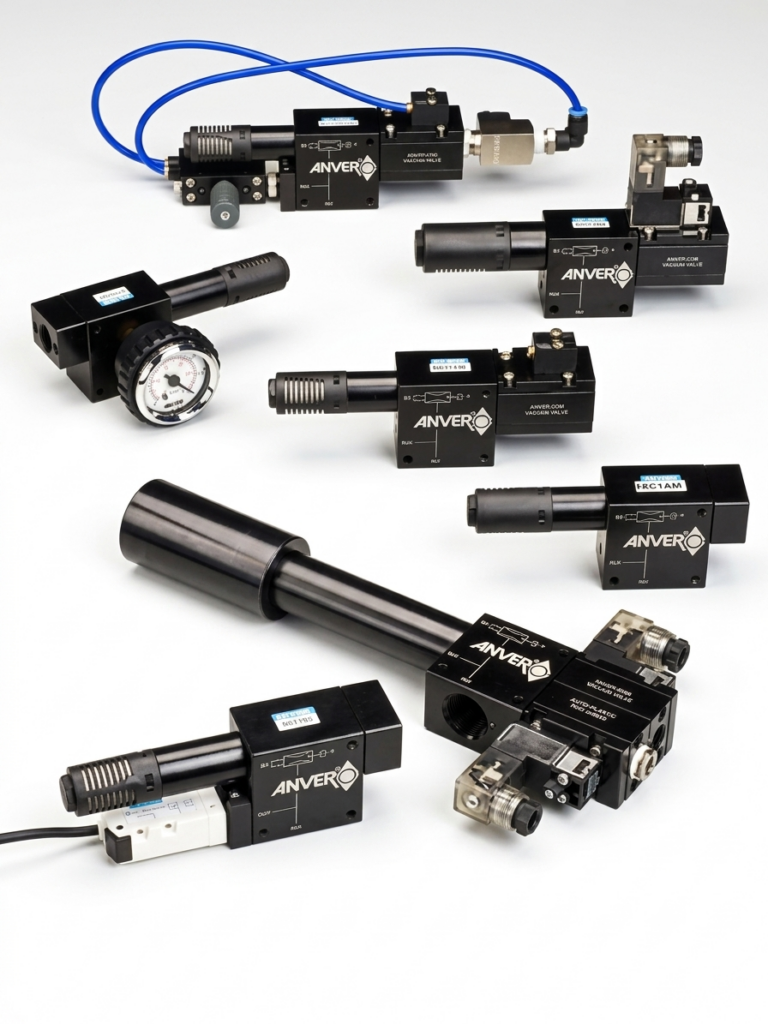
ANVER’s Automatic Flow Sensing Valves are an excellent choice when using large groups of vacuum cups where some may not fully cover a load. The sensing valves conserve vacuum for only the cups that are on the load. The more vacuum cups you have the more impressive the results. The closer to the cup the better they work as they have less air to evacuate and are faster to attach and release. The straight threads ensure all the cups are at the same level, so you can use a few to hundreds of these sensing valves on a vacuum plenum. These valves may allow for a smaller pump to be used in many applications, which pays for itself.
Features
Function
- Spring-loaded float – engages vacuum seal and prevents vacuum loss
- Vacuum conservation using metered flow sensing technology
- Internal filter
Mounting
- Versatile orientation on cup or in-line
- Direct valve-to-vacuum cup mount
Value
- Low cost
Note: These valves are designed to not seal shut completely. This purposeful small vacuum loss allows the valves to have immediate vacuum when placed on a load.
Applications
These valves are for non- and semi-porous loads. An example of a typical application is handling a complete layer of cans from a skid layer where some objects may be missing occasionally. Other applications include:
- Automation
- Packaging
- Plant operations
- Pick and place
Note: Do not use in dusty, dirty environments. Field-tests show that sensing valves are not suitable for dirty or dusty environments. Heavy stone dust, slurry, abrasives, or dusty wood can clog the valves. A blow-off system is helpful, but it will not ensure that heavy debris will be purged after each cycle. Using filters between the cups and the vacuum pump may be a better option for these types of applications. Call ANVER to learn more.
Specifications
| Vacuum sensing valves | |
|---|---|
| Parameter | Value |
| Internal float | Acetal plastic |
| Body | Anodized aluminum |
| Spring | Stainless steel |
| Temperature | 0° to 200°F (-18° to 93°C) |
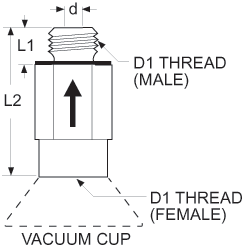
d · D1 · L1 · L2 dimensions
Sensing Valve Specifications
| Part number | d diameter [in. (mm)] | D1 top & bottom thread | L1 length [in. (mm)] | L2 length [in. (mm)] | Hex size [in. (mm)] | Level compensator suspensions | 3D models |
|---|---|---|---|---|---|---|---|
 ASV18 ASV18 |
0.16 (4) | G 1/8″ (BSPP) | 0.26 (6.5) | 1.42 (36) | 0.51 (13) |   |
SolidWorks · TraceParts |
 ASV14 ASV14 |
0.16 (4) | G 1/4″ (BSPP) | 0.33 (8.5) | 1.50 (38) | 0.67 (17) |  |
SolidWorks · TraceParts |
 ASV38 ASV38 |
0.16 (4) | G 3/8″ (BSPP) | 0.47 (12) | 1.65 (42) | 0.87 (22) | |
SolidWorks · TraceParts |
NOTE: The SLSA 1 and 2 Suspensions can be used on the ASV18 Vacuum Sensing Valve. The SLSA-2 fits on the ASV18 with an adapter but if it is too large for small cups, the SLSA 1 can be used as an alternative.
The “G” thread is also known as BSPP, commonly used world-wide for vacuum applications. See the thread conversion chart.
Reviews
There are no reviews yet.